
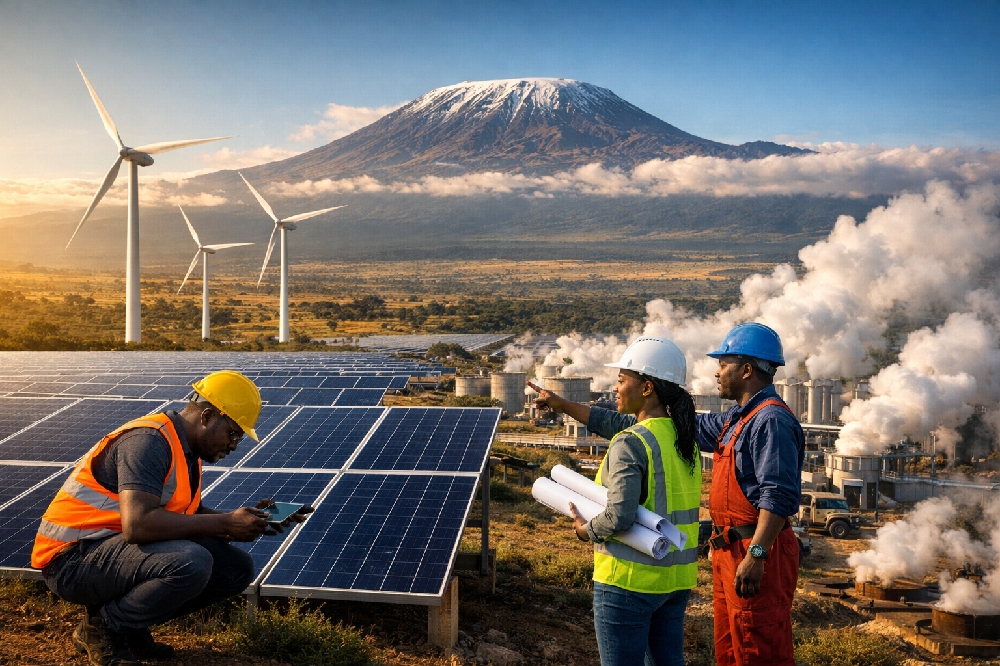
While the World Debates Energy Transition, Africa Is Building It
NNOLI SYLVESTER CHIKELUE@sylvesternnoli140312
4 months ago
While the World Debates Energy Transition, Africa Is Building It
In policy forums from Brussels to Washington, the energy transition is often framed as a future tense problem: targets to be met by 2030, neutrality by 2050, pathways still under negotiation. In much of Africa, however, the transition is not theoretical. It is happening out of necessity, improvised, uneven, sometimes messy, but undeniably real.
Across the continent, renewable energy is not simply a climate commitment. It is a development strategy.
In countries where grid infrastructure has historically struggled to meet demand, solar has leapt ahead of bureaucracy. Mini-grids now power rural clinics, schools, and small businesses far from national transmission lines. Pay-as-you-go solar systems have brought electricity to households that were never formally connected. In urban centers, rooftop installations are expanding as businesses hedge against unreliable supply and rising tariffs.
South Africa offers a striking example. Years of load shedding triggered a surge in private solar installations, turning households and commercial buildings into small-scale generators. Municipalities have begun adjusting regulations to allow excess electricity to feed back into local grids. What began as crisis response is evolving into distributed energy reform.
Elsewhere, utility-scale ambition is reshaping national planning. Morocco’s Noor solar complex has positioned the country as a renewable energy exporter in waiting. Kenya’s geothermal investments have made it one of the world’s leaders in clean baseload power. Egypt has scaled up large solar parks in partnership with international investors, blending climate finance with domestic demand growth.
These projects do not erase Africa’s energy challenges. More than 600 million people on the continent still lack reliable access to electricity. Fossil fuels remain embedded in several economies. Financing costs for renewable infrastructure are higher than in Europe or North America, slowing expansion despite abundant sunlight and wind potential.
Yet the direction of travel is clear.
Unlike industrialized economies retrofitting century-old grids, many African countries are building systems with fewer legacy constraints. Distributed solar, battery storage, and hybrid mini-grids can be integrated from the outset. In regions where diesel generators once filled gaps, solar-plus-storage is increasingly competitive. In agricultural zones, solar irrigation reduces both fuel costs and vulnerability to price shocks.
There is also a geopolitical dimension. As global powers compete over critical minerals essential for batteries and clean technologies, African countries are seeking greater leverage in how lithium, cobalt, and manganese are processed and exported. The transition is not only about electrons; it is about industrial positioning.
Critics argue that Africa’s contribution to global emissions is small, and therefore its transition matters less. That logic misses the point. The continent’s energy pathway will shape the living standards of a population projected to double by 2050. Whether that growth is powered by distributed renewables or expanded fossil infrastructure will have profound implications, for jobs, public health, trade balances, and climate resilience.
While wealthier nations debate timelines and political trade-offs, parts of Africa are advancing through pragmatism. Solar panels are appearing not because of ideology, but because they work. Mini-grids are spreading not as pilot projects, but as commercial enterprises. Energy transition here is less about slogans and more about service delivery.
The global conversation often asks when the transition will accelerate. In many African communities, the better question is: how can it be scaled faster?
The world may still be debating. Africa, in critical ways, is already building.






















































12 days ago