
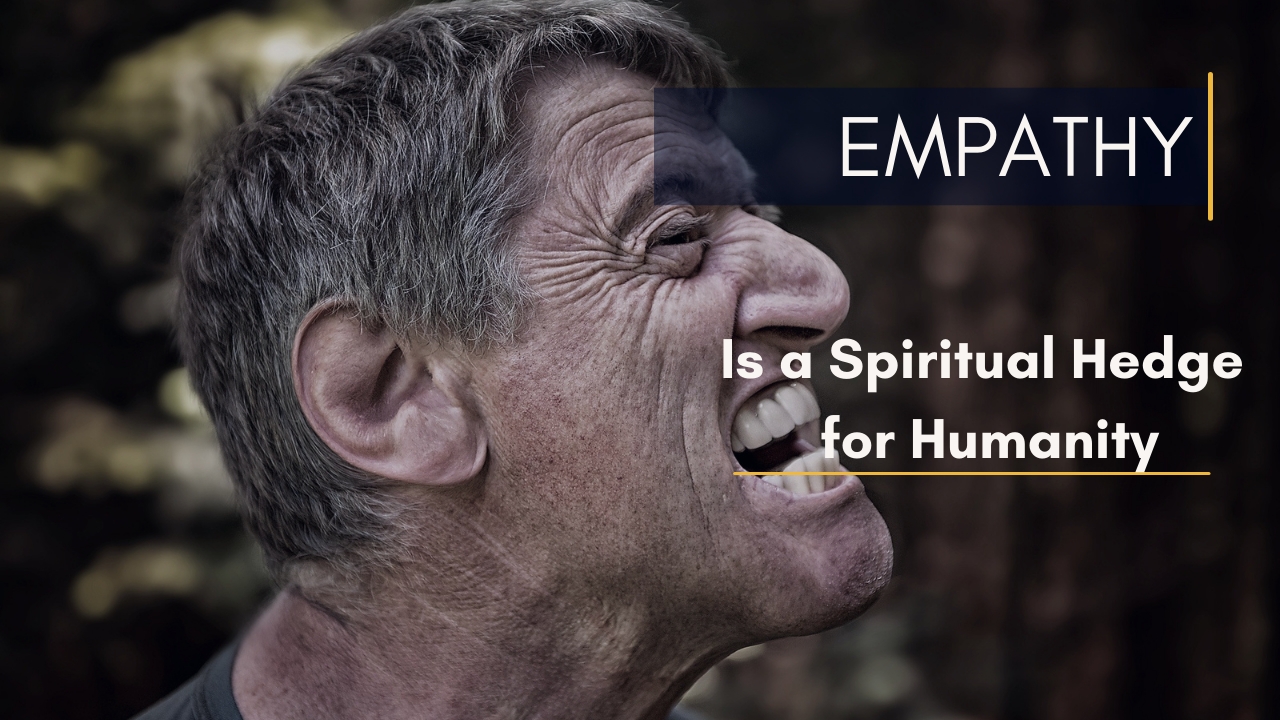
Empathy Is a Spiritual Hedge for Humanity
Makinde Kehinde Margret@kehindemargretmakinde
5 months ago
The greatest threat to humanity where other threats stems from is not artificial intelligence, economic instability, or geopolitical conflict. It is human intelligence operating without the core component of emotional intelligence, empathy .
The time that has gone by shows this in a rippling form: whenever brilliance outruns compassion, progress becomes predatory, when this happens there must be a prey lurking in every sector. Empathy is the invincible invisibly hedge standing between civilization and collapse. Empathy operates spiritual, moral, and psychological levels. This profound truth was dramatized by 20th Century Fox in 2008’s The Day the Earth Stood Still, where the world’s fate shifts because of human compassion.
Professionals are taught to optimize systems, harness the full potential of their outputs, and anticipate and mitigate risk at every stage before, during, and after processes unfold. Yet the most devastating failures in human history were not the result of ignorance, but of 360° intelligence—cognitive, creative, and productive unchecked by empathy.
Humanity often perceives love as weakness, a notion reinforced by countless works of art where protagonists lose everything or even die because of their devotion. In films like Romeo and Juliet (1996), Shakespeare’s tragic lovers perish because of their unwavering love. Similarly, Titanic (1997) depicts Jack sacrificing his life for Rose, cementing the cultural idea that love entails loss.
In literature, novels such as Wuthering Heights (Brontë, 1847) portray love as destructive and consuming, while in plays like Othello (Shakespeare, 1603), love and trust intertwine with betrayal and tragedy. Poetry, too, often links love with suffering Elizabeth Barrett Browning’s Sonnets from the Portuguese (1850) which explores the fragility and endurance of the human heart. Even visual arts capture this sentiment, such as Edvard Munch’s The Kiss (1897) and The Dead Mother (1897) evoke both the intensity and the pain of love. These recurring depictions condition society to view love and, by extension, empathy as emotional indulgence rather than as a vital moral, spiritual, and psychological force capable of shaping humanity for the better.
Empathy is spiritual intelligence in action, the capacity to remain human in core wielding power, expertise, and authority. Scripture frames this responsibility clearly: “Do not look only to your own interests, but also to the interests of others” (Philippians 2:4). In an era driven by metrics, automation, and acceleration, empathy has become the moral hedge that prevents efficiency from erasing humanity.
Empathy as a Spiritual Hedge
A hedge exists to define boundaries and prevent erosion. Spiritually, empathy performs the same function within human systems. It restrains cruelty, moderates ambition, and anchors power to conscience.
Without empathy:
• Leadership metamorphosises into domination
• Innovation metamorphosises into exploitation
• Productivity metamorphosises into burnout
The biblical instruction to “carry each other’s burdens” (Galatians 6:2) is both moral and structural. Systems survive when the people within them are protected.
Empathy in Professional Practice: Evidence Over Ideology
Empathy is far from an abstract philosophy. When approached mindfully, it becomes an intentional, measurable practice—one devoted to improving our world, our spaces, and the people within them.
Businessolver’s 2018 State of Workplace Empathy Study found that 92% of employees were more likely to remain with organizations where leaders demonstrated empathy, and 87% of executives linked empathy directly to financial performance. This confirms what professionals have long observed: cultures that value human understanding outperform those that prioritize output alone. Harvard Business Review has consistently reported (2013–2023) that empathetic leadership improves trust, collaboration, and long-term performance. Employees who feel understood are significantly more engaged, innovative, and resilient.
Empathy does not strip the world of competence; rather, it integrates competence with conscience.
Empathy as Risk Management
In law, medicine, finance, technology, and governance, the absence of empathy multiplies risk. Ethical breaches, reputational collapse, employee disengagement, and public distrust often trace back to decisions made without regard for human impact.
The OECD emphasized in its 2019–2024 trust and governance reports that public confidence erodes rapidly when policies lack human-centered consideration. Scripture warned of this long ago: “Woe to those who make unjust laws” (Isaiah 10:1).
Empathy functions as early-warning intelligence, and anticipates harm before damage becomes irreversible.
Empathy in Public Policy and Governance
Policy devoid of empathy quickly transforms into regulation stripped of humanity. The UN’s Human Development Reports (1995–2025) demonstrate that inclusive, empathetic governance strengthens societal stability and curtails conflict at every level.
Empathetic policymakers hear both the stories of lived experience and the evidence of data, recognizing that numbers alone cannot capture the human dimension. Proverbs 31:9 anchors this responsibility: “Speak up and judge fairly; defend the rights of the poor and needy.” Empathy in policy is not biasit is a justice-informed leadership.
Empathy in Healthcare Leadership
Healthcare is the arena where empathy manifests most clearly, preserving life and rebuilding trust between caregivers and communities.
Studies published in JAMA (2011–2020) show that empathetic physicians improve patient outcomes, increase treatment adherence, and reduce malpractice claims. The World Health Organization reinforced this in its 2016–2023 People-Centered Health Services Framework, emphasizing that compassion is a clinical competency and not a soft skill.
As Jesus demonstrated, “He had compassion on them, because they were harassed and helpless” (Matthew 9:36). Empathy in healthcare is far more than kindness—it is medical intelligence, it is an essential form of medical intelligence, inspired by the healing and protective power symbolized by Moses’ serpent.
Empathy in Technology and AI Leadership
Technology scales power faster than morality. Without empathy, innovation risks dehumanization, surveillance abuse, and algorithmic injustice.
The IEEE’s Ethically Aligned Design (2019) and UNESCO’s 2021 Ethics of Artificial Intelligence Recommendations both emphasize empathy as a safeguard against bias and systemic harm. Human-centered AI frameworks across Europe (2020–2025) now explicitly require empathy-driven design principles.
Micah 6:8 speaks directly to tech leadership: “Act justly, love mercy, and walk humbly.” Empathy metamorphosises into the missing governance layer in innovation.
Empathy Is Not Weakness
Far from diminishing responsibility, empathy sharpens accountability, letting love guide every step—surveying, laying foundations, building walls, plastering, roofing, and flooring the structures of human insight and pursuit. Everything we have done, are doing, and will do contributes to building here and us. Empathy does not lower standards; it elevates and humanizes excellence.
True empathy:
• Corrects with zero humiliation
• Leads with zero dehumanization
• Disciplines with zero destruction
Scripture balances compassion with strength: “Be sympathetic, love one another, be compassionate and humble” (1 Peter 3:8).
Historical and Contemporary Proof
From the rise of humanistic psychology in the 1960s (Carl Rogers, 1961) to modern corporate and institutional turnarounds, empathy has proven itself a stabilizing and trailblazing force. Leaders who embraced empathy rebuilt trust and systems. Those who rejected it achieved dominance in short-term and collapse in long-term .
Conclusion
Empathy is not a luxury for idealists; it is a spiritual hedge for professionals entrusted with power. In a world where intelligence is abundant and compassion is scarce, empathy metamorphoses into the architecture that holds humanity together.
The question is no longer whether empathy matters, but whether any progress can survive without it. As Romans 12:15 reminds us: “Rejoice with those who rejoice; mourn with those who mourn.” This is not sentimental, spiritually emotional intelligence, it is a form of ultra-intelligent and civilization-level safeguard.
Before your next decision, pause and ask:
Does this advance efficiency or protect humanity?
Choose empathy. It may be the most strategic leadership move you ever make.
References
Association for Humanistic Psychology. (1963). Foundations of humanistic psychology. AHP.
Barrett Browning, E. (1850). Sonnets from the Portuguese. Chapman & Hall.
Brontë, E. (1847). Wuthering Heights. Thomas Cautley Newby.
Businessolver. (2018). State of workplace empathy study. Businessolver.
Businessolver. (2019). The cost of the empathy deficit in the workplace. Businessolver.
Cameron, J. (Director). (1997). Titanic [Film]. 20th Century Fox / Paramount Pictures.
Davis, M. H. (1983). Measuring individual differences in empathy: Evidence for a multidimensional approach. Journal of Personality and Social Psychology, 44(1), 113–126.
European Commission. (2020–2025). Human-centric artificial intelligence policy frameworks. European Union.
Forbes. (2024–2025). The ROI of empathy: Leadership, culture, and performance. Forbes Media.
Harvard Business Review. (2013–2023). Empathy, leadership, and organizational performance. Harvard Business Publishing.
Institute of Electrical and Electronics Engineers (IEEE). (2019). Ethically aligned design: A vision for prioritizing human well-being with autonomous and intelligent systems. IEEE.
Luhrmann, B. (Director). (1996). Romeo + Juliet [Film]. 20th Century Fox.
Munch, E. (1897). The Dead Mother [Painting]. National Gallery, Oslo.
Munch, E. (1897). The Kiss [Painting]. National Gallery, Oslo.
Organisation for Economic Co-operation and Development (OECD). (2019–2024). Trust in public institutions and ethical governance. OECD Publishing.
Rogers, C. R. (1961). On becoming a person: A therapist’s view of psychotherapy. Houghton Mifflin.
Shakespeare, W. (1603). Othello. Thomas Walkley.
The Day the Earth Stood Still. (2008). Directed by Scott Derrickson; Keanu Reeves, Jennifer Connelly, Jaden Smith [Film]. 20th Century Fox.
United Nations Development Programme (UNDP). (1995–2025). Human development reports. United Nations.
UNESCO. (2021). Recommendation on the ethics of artificial intelligence. United Nations Educational, Scientific and Cultural Organization.
World Health Organization (WHO). (2016–2023). Framework on integrated, people-centred health services. WHO Press.
Visual content designed by Kehinde Margret Makinde using Canva. Design
#empathyInleadership #professionalethics #spiritualintelligence #workplacewellbeing #healthcareleadership #patientcenteredcare
#ethicalaI #empathyintech
#empathyinart #literatureandlife
#faithandwork #hellonircle #nirclefeeds #nirclewriters
#biblicalleadership
#HelloNircle




























8 hours ago