
The Middle East Flashpoint: How One War Is Testing U.S. Power and Shaking the Global Order —By Mal Ibrahim M. Nura
Potiskum LGA Eyes@muhammadnuraibrahim848393
1 month ago
The conflict now unfolding in the Middle East is no longer a localized confrontation or a familiar cycle of regional hostilities. It has evolved into a defining geopolitical moment—one that is openly testing the authority of the United States and exposing growing cracks in the global order established after the Cold War.
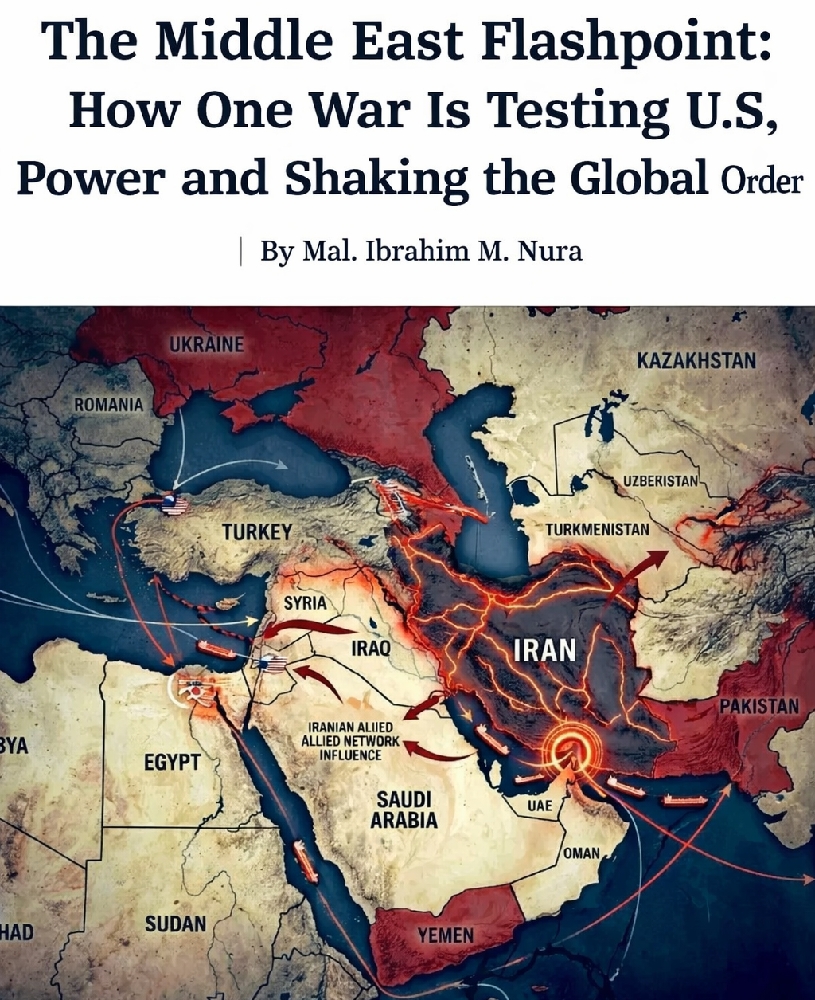
At the center of this escalation stands Iran. Washington’s apparent calculation was that the killing of Ali Khamenei would paralyze Iran’s command structure, weaken its security apparatus, and force strategic retreat. Instead, Tehran responded with cohesion and resolve. The state did not fragment; its institutions absorbed the shock and recalibrated, demonstrating that Iran’s power architecture is systemic—not personal.
More striking, however, is how Iran has expanded the battlefield beyond missiles and military bases into the global economy. By threatening disruption in the Strait of Hormuz, through which nearly one-fifth of the world’s oil supply passes, Tehran has effectively internationalized the conflict. Energy markets have reacted nervously, inflationary pressures have intensified, and economies in Europe and Asia now find themselves indirectly entangled in a war they did not choose.
On the military front, Iran has leaned heavily on its asymmetric doctrine, often described as the Axis of Resistance. Allied forces operating across Iraq, Lebanon through Hezbollah, and Yemen via the Houthis have intensified pressure on multiple fronts. The result is strategic overstretch—forcing the United States to divide its attention, resources, and political capital across an expanding theater of tension.
Washington now faces an unenviable dilemma. Escalation risks dragging America into a prolonged and costly conflict with no clear endgame. Caution, however, carries its own price: diminished credibility and the perception that U.S. power has limits others can now test.
This is why the current crisis matters far beyond the Middle East. It is a live stress test of a global system long shaped by American dominance. History suggests that major shifts in world power often announce themselves first in this volatile region.
The pressing question is no longer whether this war will reshape Middle Eastern politics—but whether it marks the opening chapter of a new era in global power relations.