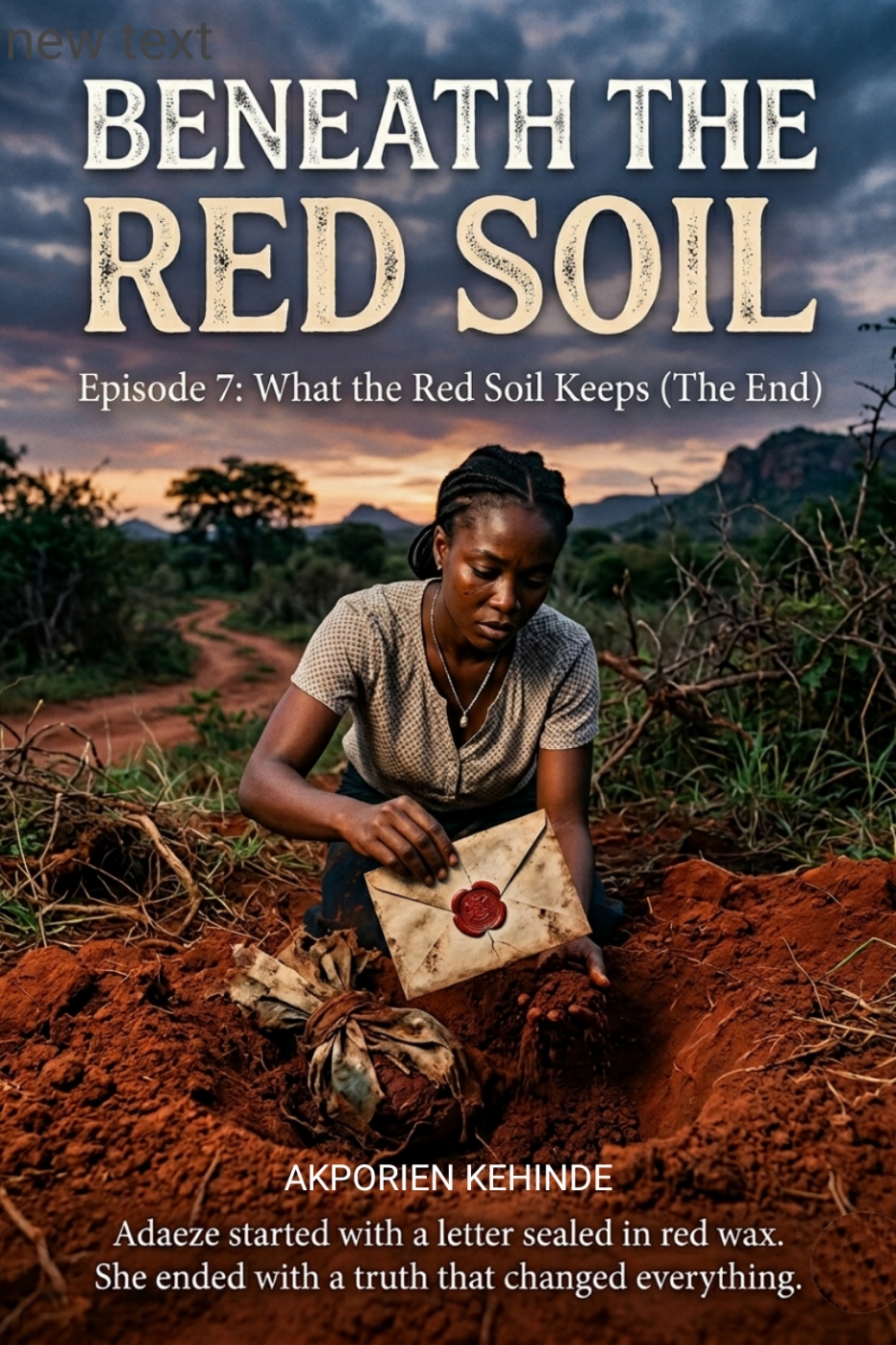
BENEATH THE RED SOIL Episode 7: What the Red Soil Keeps (The End)
KEHINDE AKPORIEN@akporienkehinde866986
1 month ago
She started with a letter sealed in red wax. She ended with a truth that changed everything. BENEATH THE RED SOIL
The move against Obi came on a Tuesday.
Eleven days after the recording dropped. Eleven days of investigations announced and press conferences held and powerful men sweating through expensive agbadas on national television. Eleven days of Nigeria arguing with itself those who believed the evidence and those who needed not to while the legal machinery that Obi had spent three years quietly assembling groaned and shuddered and began, slowly, to turn.
Adaeze was in Obi's office when the men arrived.
Four of them. Plain clothes again. But this time carrying something worse than threats carrying papers. Official papers, stamped and signed, handed to Obi's receptionist with the brisk efficiency of people who had learned to make injustice look administrative.
Obi read the documents without expression.
Then she set them on her desk and looked at Adaeze.
"They've suspended my practicing license," she said. "Pending an investigation into professional misconduct." A pause. "Filed by the Nigerian Bar Association. Which, as of last month, has a new chairman." Another pause. "Appointed on the recommendation of Senator Emmanuel Dike."
The room was quiet.
"They're trying to cut off your hands," Adaeze said.
"Yes." Obi folded the documents neatly. "Eleven days ago I would have said this was their strongest move." She stood up, straightened her blazer, and reached for her phone. "Today it is too late."
"What do you mean?"
Obi looked at her with the calm of a woman who had built her strategy across three years precisely because she knew this moment was coming.
"I mean," she said, dialling, "that I filed the full case with the International Criminal Court nine days ago. I mean that every document, photograph and audio recording exists in seventeen locations across four countries. I mean that the two witnesses who recanted last year have re-filed their statements from London, where Emmanuel Dike's reach does not extend." She put the phone to her ear. "And I mean that suspending my license stops me practising in Nigeria. It does not stop the ICC. It does not stop the journalists. It does not stop what has already been set in motion." She almost smiled. "He moved too late. He should have done this before the tapes."
Into the phone she said: "Yes. They're here. Proceed."
What proceeded was this:
At 2 p.m. that Tuesday, three senior lawyers from the Socio-Economic Rights and Accountability Project held a press conference on the steps of the Federal High Court, presenting the full case file every document, every photograph, the complete audio recording as exhibits in a formal criminal complaint against Senator Emmanuel Dike and former presidential frontrunner Pius Okonkwo.
At 3 p.m., Okonkwo announced his withdrawal from the presidential race.
At 4 p.m., the Department of State Services confirmed that Senator Emmanuel Dike had been invited for questioning and had in the delicate language of official statements declined to present himself voluntarily.
At 4:47 p.m., he was arrested at the private terminal of Nnamdi Azikiwe International Airport.
He was carrying a passport and a bag packed for a long journey.
Adaeze watched the footage on her phone the Senator in his agbada, surrounded by DSS officers, his face doing the thing powerful faces did when power left them: collapsing inward, losing its architecture, becoming suddenly ordinary. Suddenly old.
She watched it once. Then she put her phone away.
She went back to Umueze three weeks later.
Alone this time. No tin, no evidence, no one following her down the narrow red earth roads. Just Adaeze and a small bunch of white flowers and the particular grief of someone who had found the truth and discovered that truth, however necessary, did not fill the spaces left by the dead.
She visited her uncle's grave first.
It was beside his mother's her grandmother's in the family plot behind the compound, freshly mounded red earth under a simple white cross. She stood there for a long time without speaking. She had rehearsed things to say and found, standing here, that none of them were adequate. Forgiveness was too simple. Anger was too late. What she felt was something more complicated a grief that held his betrayal and his love in the same hand and refused to put either one down.
"I understand why you were afraid," she said finally. "I don't excuse it. But I understand it."
She laid the flowers down.
Then she walked to the old compound. Through the gate, past the courtyard, to the mango tree in the corner where the afternoon light came through the leaves in pieces and the red soil was still soft where they had dug.
Mama Ngozi was already there.
She was sitting on an overturned bucket with the particular stillness of someone who has been waiting long enough that waiting has become its own form of peace. She looked up when Adaeze came and said nothing. Just nodded once the nod of a woman who had held a secret for thirty years and had finally, at considerable cost, been allowed to set it down.
Adaeze sat on the ground beside her.
They stayed like that for a while the old woman and the young one, under the mango tree in the red Anambra afternoon not talking, not needing to. The compound was quiet. The earth was ordinary. The sky above Umueze was the particular blue of a sky that has no interest in human drama and never has.
"Your father loved this compound," Mama Ngozi said eventually. "He used to sit under this tree and read. He said it was the quietest place in the world."
Adaeze looked at the tree. Tried to build him from the detail a young man, a book, the same filtered afternoon light.
"What was he like?" she asked. Not the man in the photograph. Not the civil servant with the briefcase full of truth. Just what was he like.
Mama Ngozi considered this with the seriousness it deserved.
"Stubborn," she said. "Funny, when he trusted you enough. He could not walk past an injustice without stopping it was like a physical inability. He tried to teach himself to look away and never could." She glanced at Adaeze sideways. "You have that."
"My mother called it recklessness."
"Your mother called it recklessness because she loved you and was afraid for you." Mama Ngozi's voice was gentle. "They are the same thing, sometimes. Love and fear. They wear each other's clothes."
The afternoon settled around them. Somewhere beyond the compound wall a generator started up, coughed, settled into its rhythm. A child laughed somewhere. A bird made its argument to the sky.
Adaeze thought about her mother — writing a letter at a kitchen table in Surulere, pressing a scorpion seal into red wax, placing it in the false bottom of a jewellery box that held nothing important. Waiting for a daughter brave or reckless enough to do what she herself had been too afraid to do.
She had not been too afraid, Adaeze understood now. She had been too alone.
She had been waiting for Adaeze to grow into someone she could hand it to.
On the flight back to Abuja, Adaeze opened her laptop and started to write.
Not a news article. Not a legal brief. Something else something that began with a morning in Surulere and a jewellery box and a sky that couldn't decide whether to rain, and moved through red earth roads and mango trees and a tin buried thirty years deep and the voices of men who had believed that what was buried stayed buried.
She wrote for three hours without stopping.
When the plane landed she had the first chapter of something she didn't yet have a name for a true account, a testimony, a daughter's reckoning with what her parents had given her and what they had been unable to survive giving.
She would find a title later.
For now she saved the document, closed the laptop, and walked out into the Abuja evening the noise and the heat and the city going about its loud unapologetic business and felt, for the first time in as long as she could remember, the specific lightness of someone who has finished carrying something heavy.
Not emptiness. Not absence.
Just room. Space where the weight used to be.
Space for whatever came next.
The trial of Senator Emmanuel Dike began four months later. It lasted eleven weeks. He was convicted on charges of conspiracy to commit murder, fraud, and abuse of public office. He was sentenced to twenty-five years.
Pius Okonkwo, the former presidential frontrunner, received a separate conviction for accessory and financial complicity. He served seven years.
Obiageli Mensah's practicing license was reinstated within thirty days of the arrest. She went on to lead the prosecution team.
Mama Ngozi attended the verdict on a Tuesday. She wore her best ankara and said nothing to the press. On the way home she stopped at the compound in Umueze, sat under the mango tree, and stayed until the sun went down.
Adaeze Okafor's book, "What the Red Soil Keeps," was published the following year. It spent fourteen weeks at number one.
She dedicated it to two people.
Her mother. And her father whose name, finally, everyone knew.
THE END
#BeneathTheRedSoil
#NircleStories
#Thriller
#SeriesFinale
#NigerianThriller
#MustRead
#CompleteStory
#NirclwBookClub
#NircleStories
#TheEnd
#Episode7
#NigerianWriter
#Betrayal
#poetry
#My2026onnircle
#nircleblogpost
#hellonircle
#neighbour
#poetrychapbook
#nirclepoetrycommunity
#notes
#newsfeeds
#nirclestories
#storyteller
#quoteoftheday
#followme
#Ootd